
 English
 русский
 Español
 عربى
 简体中文
23 Pin Automotive Connector Balances Density, Current and Sealing
A 23 Pin Automotive Connector has to put 23 separate circuits through a single plug, and it has to keep every one of them connected through vibration, heat and water. Wenzhou Lizone Connector Co., Ltd., based in Yueqing, Zhejiang, makes automotive and motorcycle connectors, terminals, fuse boxes and wiring harnesses, and its 23-position range arranges the contacts in 3 rows at a 4 mm pitch. That layout is a compromise between how many signals fit in a small body and how much room each contact needs for current and sealing.
Three Rows at 4 mm Pitch
A 4 mm pitch leaves clear space between contacts, which allows a plastic wall to separate each circuit. Tighter spacing would pack more pins into the plug, but the walls between them would thin out and the creepage distance between neighbouring terminals would shrink. Three rows keep the body compact in width, so the 23 Pin Automotive Connector fits a controller or a lamp unit without growing into an awkward shape.
The mating pin of the receptacle housing is 1.3 mm in diameter. A 23 Pin Automotive Connector built around that size handles the current of sensor, lighting and control lines, and keeps the terminals from being so slight that they bend when mating. Voltage is rated at 250 VAC.
Two Sides of the Connection
Headers on the Circuit Board
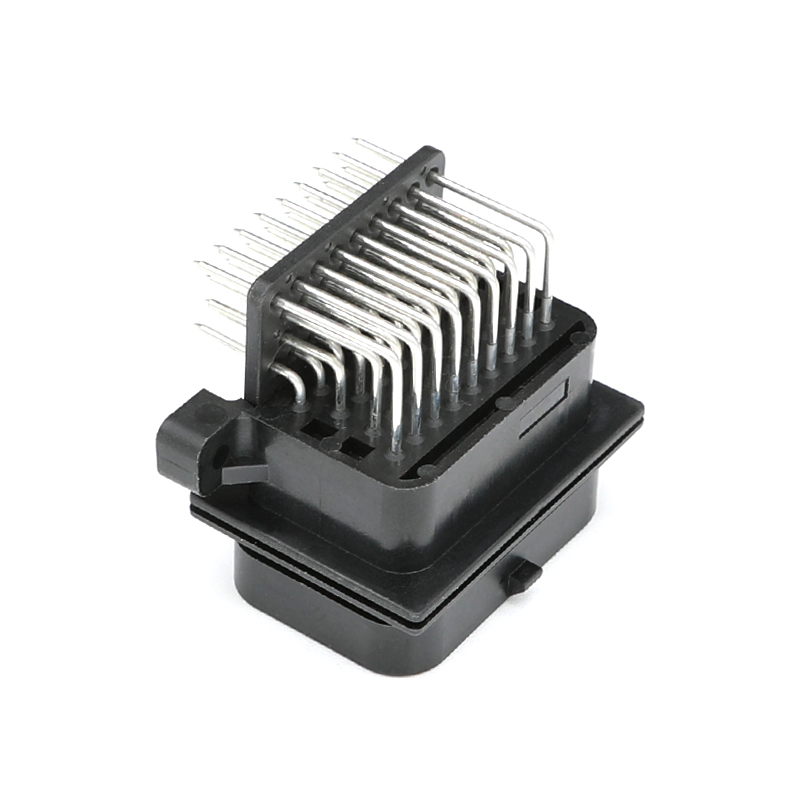
The PCB headers come as a right-angle and a vertical version. Both mount through hole with solder pins and are rated at 8 A. A right-angle header lets the plug enter parallel to the board, which suits a low enclosure, while a vertical header lets it enter from above. Each header measures 61 × 38 × 32 mm, so a 23 Pin Automotive Connector board layout can be planned around a known footprint.
Receptacle Housings on the Cable
The receptacle housing is the cable side, with crimped terminals and either cable mounting or free hanging. It carries 17 A and takes wire from 16 to 20 AWG, so a harness maker can match the wire size to the load of each circuit. The housing measures 47.5 × 35 × 38 mm, and its primary locking is integrated in the housing, which keeps the plug engaged when the vehicle shakes.
Vibration and Mating Security
Vibration is a common cause of connector faults in vehicles. Contacts that move against each other wear their plating and raise resistance, and a plug that works loose interrupts a circuit. The integrated primary lock of the housing holds the 23 Pin Automotive Connector in place against the header, and the crimp connection on the cable side gives a firm mechanical joint between wire and terminal.
Heat, Cold and Washdown
Under the bonnet and around the frame of a motorcycle, a connector faces cold starts and hot running. Headers in the Lizone range are rated from -40 to +105°C, while the receptacle housings are rated from -55 to +125°C.
Water is the other threat. Headers carry IP67 and IP69K protection, and receptacle housings carry IP6K9K, which includes resistance to high-pressure, high-temperature washdown. That rating matters for a 23 Pin Automotive Connector on a vehicle that is cleaned with a pressure washer, such as a motorcycle or a commercial vehicle.
Colours Prevent Wrong Connections
The 23-position range comes in black, white, gray and blue, with the same layout in each colour. Vehicles often carry several connectors of the same pin count in neighbouring positions, and a colour code lets the assembler pick the right pair at a glance, so a harness is not plugged into the wrong socket. Each colour has its own model number for header and housing, which keeps the pair matched in stock and on the line.
Made Where the Mould Is Controlled
Plastic housings depend on mould accuracy. A slightly off-size cavity changes the pin position, the lock engagement and the seal fit all at once. Lizone has 20 years in new product development and mould precision manufacturing, and that mould work sets the dimensions of each 23 Pin Automotive Connector from one batch to the next. The range is applied to motorcycles, cars and new energy vehicles, where the same pin layout serves lighting, control and sensor circuits.